USACS Clinical Management Tool (CMT) Program
Aligning care with the best evidence to improve efficiencies and patient safety
The Problem
Working in a busy Emergency Department (ED) or inpatient hospital setting is increasingly challenging. Managing clinical complexity, encountering high cognitive load, and sometimes dysfunctional systems of care lead to high rates of burnout. As a result, there is potential for variation in how Physicians and Advanced Practice Providers (APPs) approach specific chief complaints or diagnoses. A high degree of clinical variation is inefficient. It can also result in suboptimal patient outcomes, particularly when best practice approaches that align with the latest evidence are not used. Additionally, clinical variation increases the risk of adverse events, medical errors, and malpractice litigation.
The Solution
To address clinical variation and ensure every patient receives the same, high-quality care, USACS has developed and implemented >30 clinical management tools (CMTs). CMTs are targeted towards common presentations and diagnoses where clinical variation exists and evidence from the literature can be integrated to optimize quality of care.
CMTs are designed to be usable, helpful resources for frontline Physicians and APPs. CMTs are based upon the latest data from USACS, medical literature, and expert Clinician expertise. CMTs include carefully curated language to minimize the risk of adverse events and medical errors, and that care is delivered in the most efficient manner. Additionally, CMTs provide medicolegal protections to Clinicians, justifying medical decision-making by harnessing the power of the literature, statistical rigor, and practice bedside care.
The Result
Across USACS, CMTs are at the heart of our strategy to improve care for every patient and are regularly used on shift. In 2020, CMTs were utilized almost 94k times. This increased to nearly 176k in 2021, 284k in 2022, and 391k in 2023.
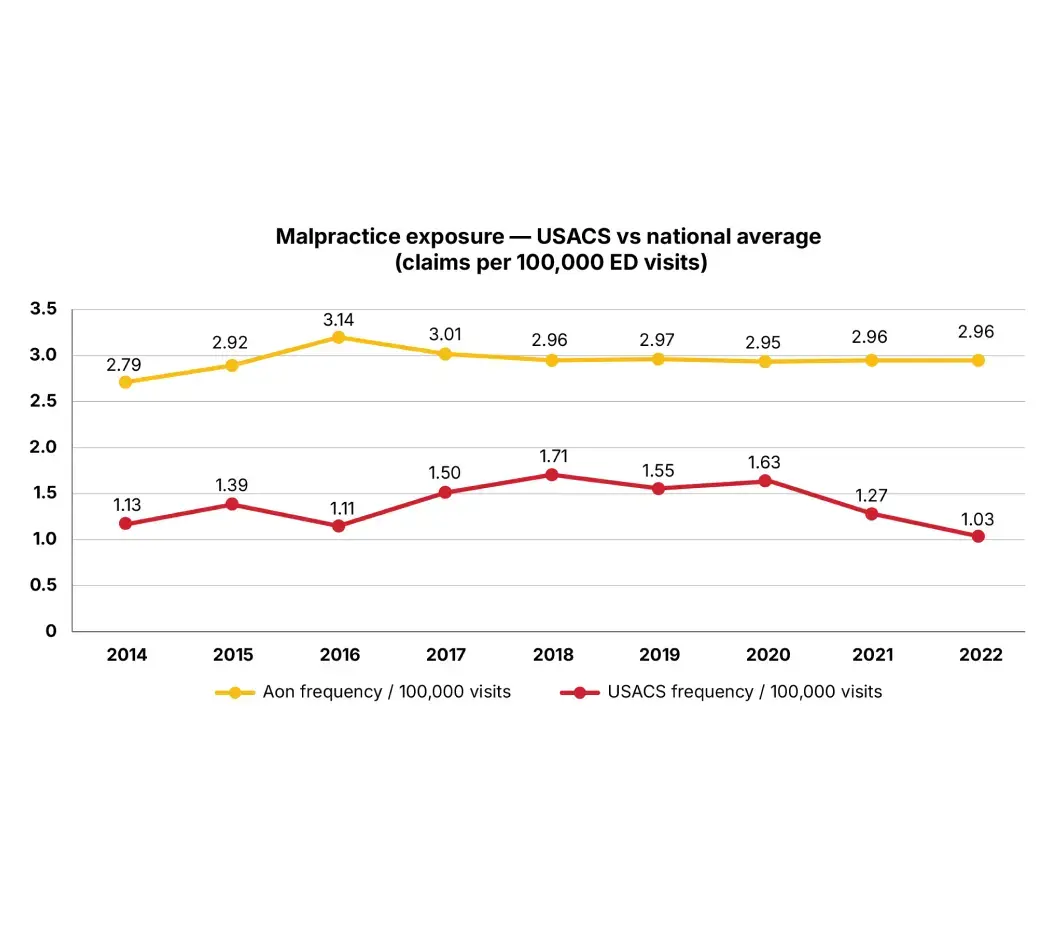
As a key result of CMTs, patient adverse events and medical errors are considerably lower at USACS sites. This is demonstrated in the rate of malpractice claim frequency among ED visits, which is half the industry average (See figure depicting USACS claims over time compared to AON, which is an industry benchmark).