Restoring Community Care
| The Challenge
Nonprofit health system partners with physician-owned practice to rapidly restore high-quality care in four community emergency departments.
When a large private equity-backed healthcare company declared bankruptcy in 2024, the fate of its hospitals in one southwestern city was uncertain. Within months, a nonprofit healthcare system that already owned several hospitals in the area announced that it would assume operations of four of the bankrupt company’s facilities.
The health system was committed to keeping the EDs open to meet the emergency needs of the community, but faced significant operational challenges. All four departments had high clinician and nurse turnover, and there was limited communication within the care teams. Patients who were admitted to the hospital were often boarded in the EDs for days, contributing to long wait times and high percentages of patients leaving the EDs without being seen (LWBS). The largest hospital had lost its residency program and trauma center designation due to quality concerns, declining patient Q volumes, and loss of coverage by community specialty providers.
For the short term, the health system transitioned the emergency medicine physicians and advanced practice providers (APPs) to its payroll. However, it was not set up to employ clinicians long-term. It needed a motivated partner with proven expertise in clinician management functions who would provide strong leadership and be a lock-step collaborator in rapidly improving performance and restoring community confidence. Prospective partners conducted town hall meetings to get to know the incumbent clinicians and understand the support they would need.
In November, the health system selected USACS as its emergency medicine partner, with a plan to transition management of all four EDs on February 1, 2025.
Image

| Quality patient care starts with taking care of our own to make sure they’re able to provide the best care for the community. We needed a partner we could all agree on, someone who could help these doctors thrive.’
|
| The Solution
The health system recruited strong nurse leaders from its legacy sites to lead the nursing teams in the new EDs. One of the first priorities was to fill nursing vacancies with candidates who had at least three years of experience.
USACS’ initial priority was to recruit and retain the medical directors who managed the four EDs and as many high performing clinicians as possible. Thanks to the practice’s world-class benefits and physician ownership model, 95% of invited physicians and 100% of APPs chose to stay. USACS’ human resources, scheduling, and credentialing departments onboarded about 40 incumbent physicians and APPs in less than 90 days. They also immediately began to recruit board certified physicians who would replace any non-board certified incumbents in the summer in alignment with the health system’s high standards for emergency care.
Before the contract was signed, USACS notified its Strategic Traveling Ambassador Team (STAT) of a possible deployment. USACS STAT Traveling Physicians provide auxiliary clinical support during contract transitions. Every physician on the team has significant experience supporting new start-ups and is a committed owner in the practice. The STAT Traveling Physicians’ efficiency and excellent patient engagement techniques helped elevate the quality of care and orient the incumbent physicians and APPs to USACS’ high standards and clinical management tools while the practice continued recruiting full-time clinicians.
With a strong care team in place, USACS and the health system immediately invested in ensuring the medical directors had the operational support to drive rapid change. USACS deployed its Clinical Resource Group (CRG), an in house team of nurses and engineers who visit individual EDs to identify opportunities to sustainably improve patient flow. The health system trusted USACS’ expertise and was quick to infuse its own resources, from joint nurse-clinician training on patient-centered care, to a Power BI dashboard that enabled the ED medical directors to better monitor performance. USACS Regional Vice President Ted Kokosinski, DO, FACEP, describes the health system as an ideal partner—organized, agile, and attentive to clinician needs.
“This hospital system is very dedicated to providing the resources we need to get the job done,” Kokosinski says. “They roll up their sleeves and do their part—and they do it without delay.”
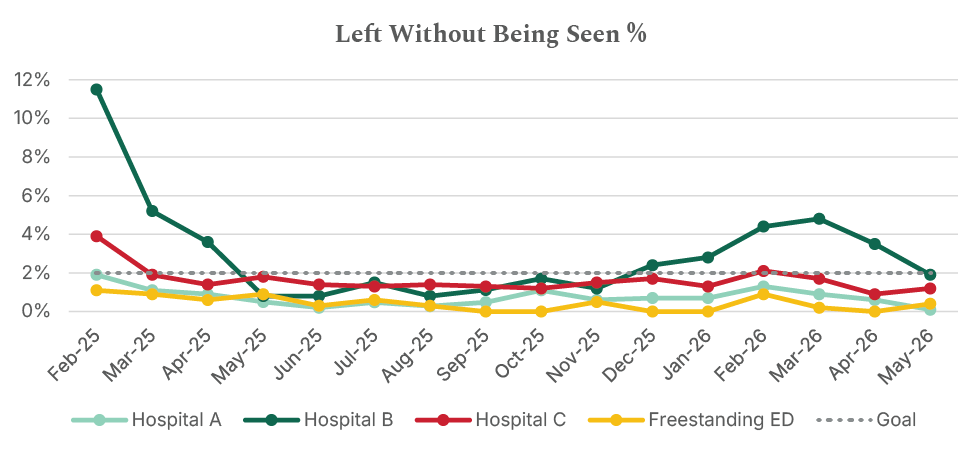
USACS worked closely with the ED medical directors throughout the transition to clearly communicate performance goals to all clinicians. Faced with chronic inpatient boarding, health system and USACS leaders set the expectation that each ED team should work with case management and hospitalists to move patients toward the next phase of care as soon as disposition is determined. Changes in front-end processes led to rapid, dramatic reductions in LWBS rates. Other metrics followed suit.
Image
|
Image

| Image

|
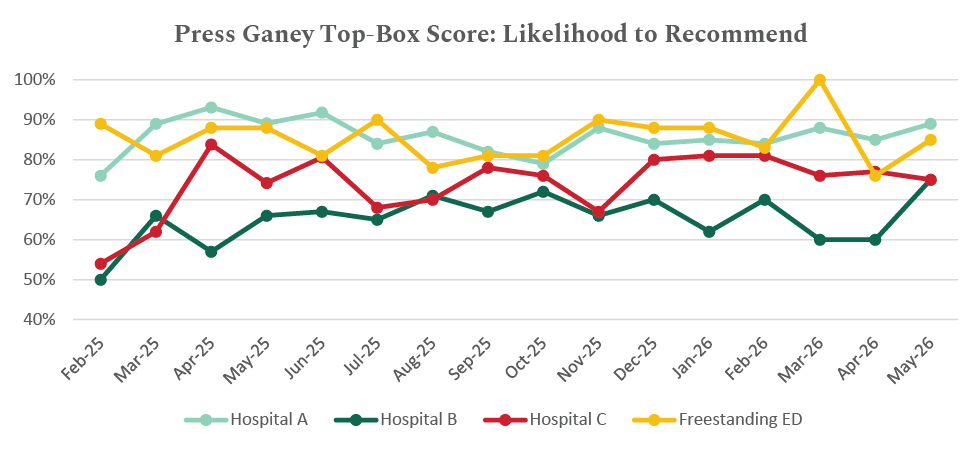
These changes restored local confidence in the EDs. Five months after the transition, the three hospital EDs had seen an average 33% improvement in patients’ likelihood to recommend the departments, according to Press Ganey survey results.
The hospitals have made strong progress in improving community relationships—from cardiologists, neurologists, and other specialists who refer to the hospitals, to law enforcement and emergency medical service (EMS) agencies who now trust that the patients they transport to these EDs are in good hands. The largest ED saw its highest EMS volumes in 2025. The ED Medical Director and nurse leaders are conducting joint trainings and mock drills with EMS and the hospital trauma team as they pursue Level I Trauma certification. The health system is also elevating the level of care available to the community with a new interventional radiology and catheterization lab at one hospital and new outpatient imaging services at another. The largest hospital is on track to resume residency programs and medical student rotations.
Image
|
Clinician satisfaction has improved as well. Twice a year, USACS asks its physicians and APPs whether they would recommend USACS as an employer. Clinicians rate the practice from 0 to 10 and responses are aggregated into a net promoter score (NPS) that can range from -100 to 100. Every clinician at the four EDs who participated in the June 2025 NPS survey said they would recommend USACS as an employer, giving the practice the highest possible NPS of 100.
The turn-around of these EDs has caught the attention of prospective clinicians. While several physicians who cautiously joined USACS part-time during the transition have since expanded to full-time, recruiters have successfully signed many highly qualified local clinicians who were attracted to USACS’ physician ownership model. The practice filled remaining vacancies by early fall and phased out the STAT Traveling Physicians. Knowing that the health system and USACS will provide the tools they need, the nurses and clinicians at each ED are focused on reducing length of stay and continuously improving quality of care.
Image
| The fact is that the community deserves a safe place to go. My family lives in this city, and I’m proud to now be able to say, ‘Yes, you can go to this hospital—and you can get great care.’
|
| The Results
Five months in to this new partnership, the EDs had achieved an average:
- 50% reduction in door-to-clinician times
- 85% reduction in the percentage of patients who left without being seen
- 22% reduction in discharge length of stay
- 33% increase in patients’ likelihood to recommend the EDs