Case Study: Change Without Pain
| The Challenge
USACS maintains top-tier performance in one of the country’s busiest EDs after seamless transition from private equity-backed group.
In January 2024, US Acute Care Solutions (USACS) assumed management of the Emergency Department (ED) at a Level I Trauma Center and three affiliated EDs in the Mid-Atlantic region. Leary of the financial instability of its incumbent emergency medicine services provider, the health system sought a partner who would keep the same high-performing clinical team and maintain top-decile patient experience and strong quality and throughput. USACS retained every clinician in the transition, performed well within goal on every metric in its first year, and invested in growing talented clinical leaders into new roles and improving system-wide capacity.
The health system serves more than three million patients annually throughout the Mid-Atlantic region, including 200,000 patients across a busy adult ED, a pediatric hospital ED, and two freestanding EDs in a single market. In 2013, a private equity-backed group purchased the local physician-owned practice that managed emergency medicine services at these four sites, as well as a pediatric fellowship program at the children’s hospital.
The four EDs had outstanding performance for left without treatment, sepsis, and other quality measures. However, when the incumbent group filed for Chapter 11 bankruptcy in May 2023, the health system decided it was time for a change in management. The group’s contract was up for renewal at the end of 2023 and it had hinted at the possible need for a financial subsidy. The well-respected emergency medicine clinicians and APPs expressed anxiety about the group’s stability and their future pay and benefits.
The health system first considered transitioning the emergency medicine clinicians to its own employed medical group, as it had done with its gastroenterologists and anesthesiologists in 2021 and 2022. In both cases, the independent groups managing these service lines had been purchased by private equity-backed companies and the health system incurred subsequent cost increases, cultural challenges, attrition, and operational disruptions. The transitions to an employed model were expensive and rocky, as the health system lacked the in-house revenue cycle management (RCM) expertise and managed care rates for these service lines. Consultants the health system engaged to evaluate the feasibility of employing the 100 emergency medicine physicians and APPs estimated the move would likely cost $5-7 million. Most of this expense would come in developing RCM capabilities that a stable, high-performing physician management practice would already have in place.
The ED clinicians proposed the idea of creating their own medical practice, but this group would also lack billing, coding, and payor negotiation expertise. Preferring the clinicians remain focused on delivering the exceptional care for which they were known, the health system began evaluating alternative outsourced options that were free of private-equity backing.
| The Solution
The health system’s priorities were to minimize disruptions to quality and performance, ensure long-term financial sustainability, and retain the incumbent ED clinicians and Medical Director. USACS, through its legacy practices, already had a successful 23-year emergency medicine partnership with the health system in another market. Health system leaders knew and trusted USACS East Division President Martin Brown, MD, FACEP. “I knew he was a straight-shooter and I could tell he would go to bat for our doctors,” the incumbent Medical Director says.
USACS held town hall meetings and social events to get to know the clinical team and understand and address concerns. In its proposal, USACS committed to maintaining current clinician compensation rates. As part of the physician-owned company’s standard hiring practice, USACS would also offer every full-time physician and APP shares and stocks in the company, respectively.
Confident in its ability to maintain outstanding performance and understanding the importance of a win-win scenario for all parties, USACS proposed to provide emergency medicine services with no financial subsidy and offered a profit-sharing model in which revenue in excess of USACS’ targets would be shared evenly with the emergency medicine clinicians.
Rather than simply agreeing to all of the clinicians’ preferences, USACS designed a model to address the long-term sustainability of the partnership. For example, the clinicians shared a common compensation rate across all four EDs and strongly desired to keep their unique arrangement of working very few weekends and relying on a separate team of nocturnists for night coverage. USACS agreed to honor the incumbent clinicians’ request, but with the health system’s approval began recruiting a new generation of physicians and APPs who would primarily practice at the freestanding EDs with a separate pay structure appropriate for that setting. New clinicians would also work a more typical rotation of night and weekend shifts. In addition to increasing the sustainability of the zero-subsidy model, this would bring in new talent and provide continuity for the health system as a number of incumbent clinicians neared retirement.
The credibility of USACS’ plan proved it was the right cultural and strategic fit. In July 2023, the health system selected USACS as its new emergency medicine partner for this market, with a start date of January 1, 2024.
"USACS’ proposal was extremely transparent. They had really thought through realistic solutions to make this partnership work long-term for the clinicians, our health system, and themselves." - Chief Medical Officer, Partner Hospital
| The Results
A Thriving Partnership
To ensure a smooth transition, Dr. Brown and the Medical Director worked in lock-step in the six months leading up to the start of services. USACS’ first priority was recruiting and onboarding the emergency medicine clinicians. USACS retained 100% of the physicians and APPs. Each individual was provided concierge onboarding services and enrolled in USACS’ world-class retirement and benefits packages. In the first year, nine of these clinicians would utilize USACS’ generous paternity or maternity leave and two would use short-term disability. All clinicians completed training in USACS risk management programs, clinical management tools, and corporate policies that would allow them to thrive in their new practice. USACS worked with the health system’s information technology team in preparation to begin data monitoring on day one of services.
With minimal disruptions to operations, the clinical team remained focused on providing high-quality care. In their first year under USACS, the clinicians performed at the same excellent level as before the transition. In 2024, the four EDs averaged in the 91st percentile ranking on Press Ganey surveys in the doctors’ overall performance domain. Patient experience has continued to improve, with each ED raising its likelihood to recommend top-box scores in 2025.
In the spring of 2024, USACS deployed its Clinical Resource Group (CRG), an in-house team of nurses and engineers who visit individual sites to evaluate opportunities to improve patient flow. The CRG helped implement best practices for optimizing throughput amid the launch of a major renovation of the adult ED. Discharge length of stay declined steadily in the last half of 2024 and throughout 2025.
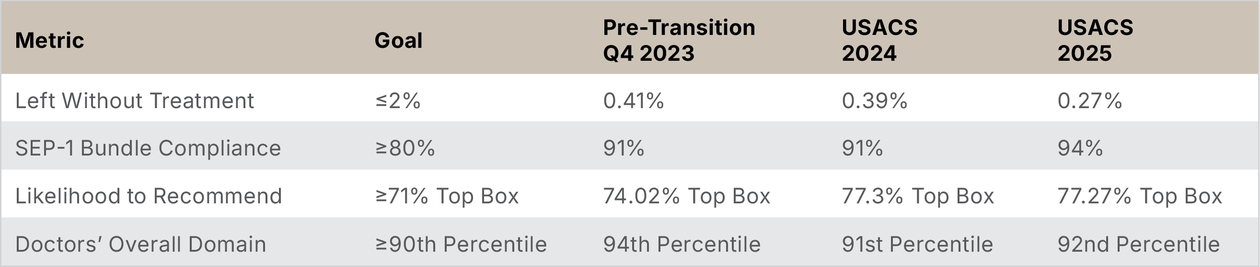
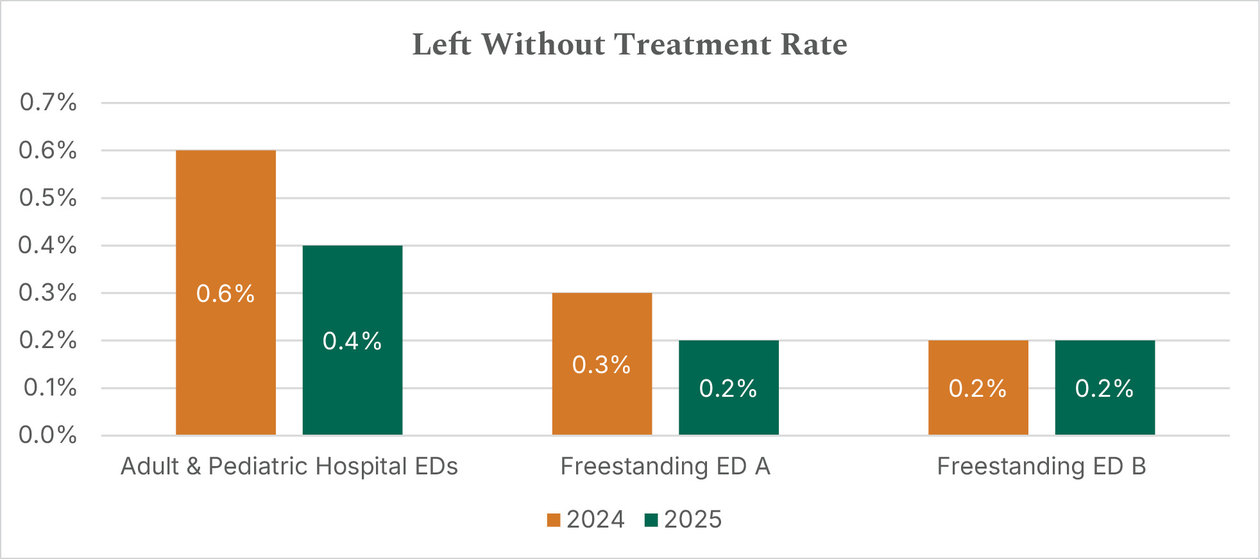
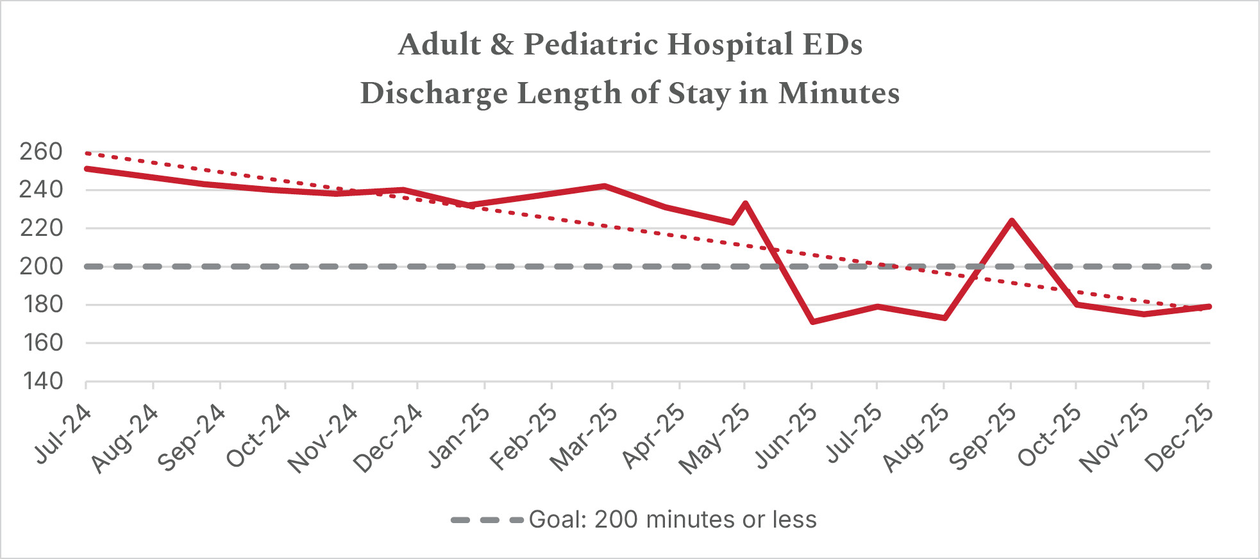
With this excellent quality and USACS’ optimized RCM infrastructure, the emergency medicine program exceeded USACS’ financial targets for 2024 and 2025. As part of the profit-sharing agreement, the emergency medicine clinicians received a financial bonus for their outstanding performance for the first time in the team’s history.
USACS prides itself on recognizing and investing in leadership talent. In July 2024, USACS appointed the Medical Director a Regional Vice President, with oversight for more than 20 clinical programs in Northern Virginia and Maryland. The former adult ED Assistant Medical Director was promoted to the role of Medical Director and joined the Medical Director of the freestanding EDs in USACS’ Scholars Program, an intensive one-year training focused on developing executive presence skills. USACS created a custom administrative fellowship for another promising clinician. These programs promote retention and enhance leadership continuity within the health system.
"I am proud that we kept 100% of our people, that we’ve continued to deliver top results, and that USACS is really transparent with coding, finances, and performance.” - Regional Vice President, USACS
The clinicians in these EDs have also had opportunities to take national roles with USACS. One serves on the National Clinical Governance Board, a team of clinicians who develop and distribute evidence-based protocols and clinical decision support tools throughout USACS sites. Another physician is now USACS’ National Director of Clinical Education.
As a solutions-oriented partner, USACS continues to collaborate with the health system on initiatives including a system-wide capacity management strategy. Recognizing that not every patient admitted from the ED of the health system’s flagship hospital requires the level of inpatient care available there, in 2025 USACS helped create a reverse transfer program. An ED Transfer Navigator at the main hospital now coordinates transfers of appropriate patients for admission at the health system’s community hospitals with their consent. This level-loading effort has helped increase weekly transfer volumes by 82%, decrease average time from transfer order to arrival at the receiving facility by nearly 30%, and achieve a nearly 40-minute reduction in average boarding hours per admission in the main ED. This increases capacity for patients in need of the level of care only this hospital can provide and improves utilization of the resources available at the smaller hospitals.
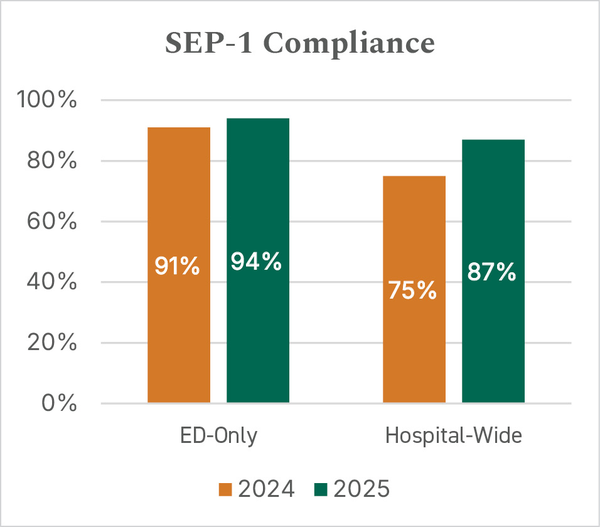
USACS and the health system have continued to grow together, expanding to an integrated emergency and hospital medicine model in another market and launching a new freestanding ED. This health system provides an excellent example of how USACS can be a like-minded strategic partner that empowers clinicians to provide world-class care. In 2025, the adult and pediatric EDs in this market both saw their highest patient volumes to date.
Asked whether the EDs experienced any disruption to care or operations during the transition, the health system’s Chief of Clinical Enterprise Operations replied, “What transition? The change from [the former group] was seamless and the quality of care is as high as ever.”
About USACS
ln 2015, the nation’s premier acute care medicine practices formed USACS, a physician-owned and physician-led company that set forth a new model for acute care management. Every full-time USACS physician is offered equity in the company, accounting for 98% of ownership and empowering the group to recruit top-quality clinicians. The remaining 2% is held by health system partners, leaving USACS unencumbered by the volatility of private equity investment. Physician ownership aligns the missions of clinicians and hospital partners to drive better quality and value. Today USACS cares for more than 11 million patients annually across more than 400 programs in 27 states.