Case Study: Integrated Acute Care Transition
| The Challenge
Texas hospitals improve efficiency and increase capacity by expanding USACS partnership to include emergency, hospital, and critical care medicine.
In October 2024, a multi-state nonprofit health system expanded its 36-year emergency medicine partnership with US Acute Care Solutions (USACS) in Texas to include hospital medicine services at seven hospitals. The health system shifted two critical care programs to USACS in February 2025 as well. By the spring of 2026, the four largest hospitals with a USACS integrated acute care model had:
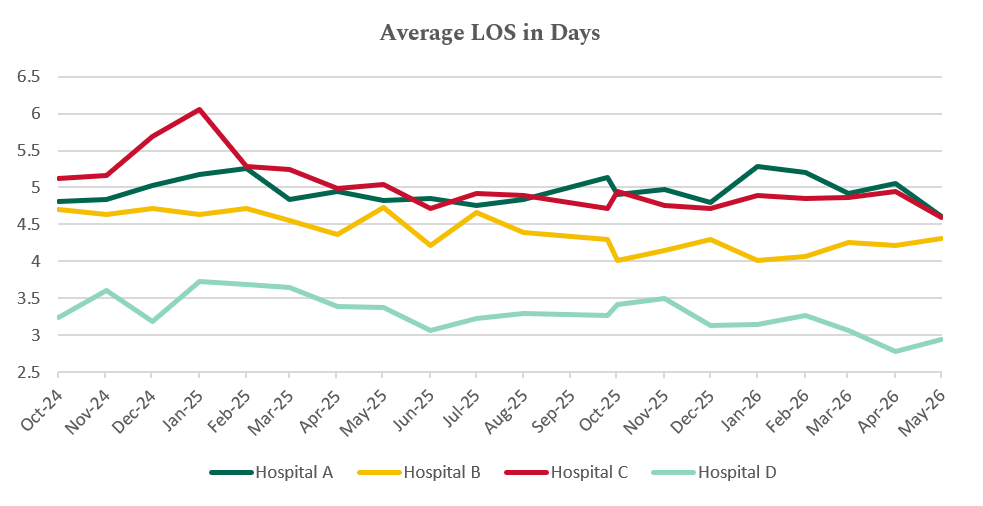
- Decreased length of stay (LOS) by more than 6%, unlocking $7.5 million in added annual profit for the health system.
- Reduced time from ED admission order to hospitalist order placement by an average of 62%.
- More than doubled the percentage of discharge orders written by 10 a.m.
USACS is the exclusive emergency medicine physician practice staffing all of the health system’s sites in Texas. In mid-2024, the partnership included 13 emergency departments (EDs) that were earning some of the highest patient experience scores among this health system’s hospitals nationally. USACS was also managing three of its ICUs, which had the lowest mortality rates in the Texas market. While these programs thrived, several of the hospital medicine programs were struggling with longer-than-desired LOS. At the largest hospital in the system, there were opportunities to reduce hospitalist turnover and improve cross-service line communication.
| The Solution
In pursuit of a more collaborative culture, the health system joined the nearly 80 USACS partners who have chosen an integrated acute care model, designed to elevate patient care through streamlined leadership, a common mission for all clinicians, seamless care transitions, and shared accountability for driving hospital-wide improvements. With the October and February transitions, USACS became the provider of integrated emergency, hospital, and critical care medicine at four of the system’s largest hospitals, ranging in size from about 120 beds to more than 500.
Thanks to USACS’ generous compensation, industry-leading benefits, and excellent reputation with emergency medicine clinicians in each hospital, the group’s dedicated recruiters retained all of the incumbent Medical Directors. USACS also retained 100% of bedside intensivists and 98% of full-time bedside hospitalists.
With its cultural challenges, the largest hospital had a nearly 50% vacancy rate in its hospital medicine program at the time of transition and provided the perfect opportunity for USACS to demonstrate the value of physician ownership and the effectiveness of the integrated acute care model. USACS’ leadership team, led by its Regional Vice President (RVP) and System Medical Director, held town hall meetings with the incumbent hospitalists to understand their challenges.
“We as physicians are not just employees working for a corporation, we are owners of our practice,” the RVP says. “Creating success for our health system partners creates success for us and helps us lead fulfilling careers.”
Strategies for improving the hospitalist work environment that emerged from the town halls included:
- Optimize Shift Map—Unbalanced workloads had led to long hours for many hospitalists and challenged department efficiency. With input from the physicians and APPs, the RVP and System Medical Director fine-tuned the shift map and formed a dedicated admissions team rather than distributing admission responsibilities among rounding hospitalists each day.
- Close the ICU—When the critical care program transitioned in February, USACS shifted to a closed ICU model in which dedicated intensivists were responsible for all-around management of critical care patients. Hospitalists would no longer juggle ventilator management and other critical care tasks with their regular floor patients.
- Improve Consultant Culture—The RVP, System Medical Director, and site Medical Directors empowered the hospitalists to establish responsive, courteous relationships with subspecialty providers in order to cut down on consultation times.
- Upgrade Work Stations—The USACS RVP advocated for workspace improvements, partnering with the hospital to ensure each clinician had adequate space, access to functioning computers, and other key resources.
- Enhance Hospitalist-Intensivist Collaboration—With a common set of goals, the hospital medicine and critical care clinicians began to overcome historic challenges and collaborated to reduce hospital-acquired infections and improve patient care.
“With hospitalists and intensivists being part of the same team, it’s no longer ‘your issue,’ or ‘my issue,’ it’s ‘our issue.’ That mindset is helping us resolve challenges easier.” - System Medical Director
By September 2025, USACS’ dedicated recruitment team had signed physicians to fill all 15 of the vacancies in the largest hospital medicine program. The improved collaboration in this program was mirrored throughout the system as USACS leaders rolled out best practices to improve efficiency, quality, and patient experience at each of the hospitals with an integrated acute care program. These included:
- Improve & Standardize Multi-Disciplinary Rounds (MDRs)—Programs that still had geographic rounding shifted to unit-based MDRs. The leadership team provided scripts to help clinicians implement best practices for effective communication with patients and staff.
- Improve Documentation Accuracy—USACS’ Chief Documentation Officer conducted training sessions to help hospitalists optimize documentation and ensure appropriate allowance for expected LOS. Medical Directors and Quality Directors began auditing charts to identify fallouts in order to provide individual coaching and opportunities for improvement.
- Streamline Communication with the ED—The integrated acute care model provided a unique opportunity to improve efficiency with streamlined communication between hospitalists and emergency medicine clinicians who were now partners and co-owners in the same medical practice. USACS set the expectation that admission orders should be placed within 30 minutes of ED disposition.
- Data Transparency—The health system and USACS agreed to share data on key performance indicators. USACS clinical leaders monitored metrics closely and began reviewing them at staff meetings and in one-on-one check-ins to help motivate clinician improvement. Some sites implemented friendly competitions to recognize the clinicians who most efficiently discharged medically ready patients.
Performance improved throughout the system. In the year following the hospital medicine transition, LOS, the health system’s highest priority for improvement, declined across the four largest integrated acute care sites. In May 2026, the four hospitals achieved an average LOS of 4.11 days. Incremental improvements have yielded significant financial gain. The additional inpatient capacity has resulted in increased admissions that generated approximately $7.5 million in added profit for the health system in fiscal year 2026 alone.
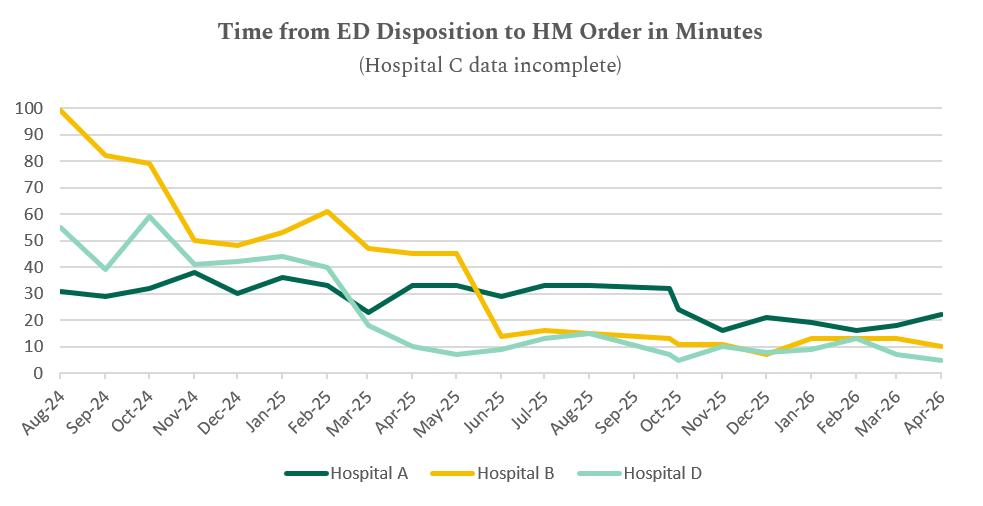
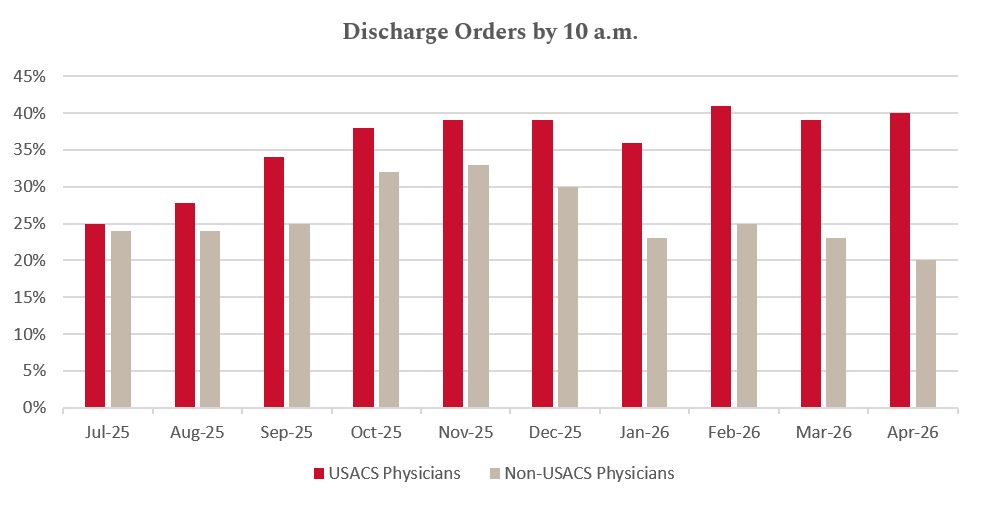
With stronger coordination between the ED and hospital medicine programs, two of the hospitals saw significant reduction in time from ED disposition to hospitalist order placement, while all four reduced admission order to ED departure time. The average percentage of patients whose discharge orders were placed by USACS clinicians before 10 a.m. has steadily increased.
With streamlined strategies to prevent healthcare-associated infections and reduce unnecessary resource utilization, each ICU has maintained extremely low rates of central line-associated bloodstream infections (CLABSI) and catheter-associated urinary tract infections (CAUTI). In 2025, observed over expected mortality in the health system’s Texas hospitals was 22% lower than its average across all markets nationally. ED, hospital medicine, and ICU leaders agree that working as an integrated team has led to more streamlined care and timely transitions for sepsis patients. Over the past year, the Texas market had 338 fewer sepsis deaths than expected for patients’ diagnoses.
In 2025, all four hospitals earned a four-star rating or higher from the Centers for Medicare and Medicaid Services’ hospital star quality rating program. Each was also recognized as a high-performing hospital in U.S. News & World Report’s 2025-2026 Best Hospitals edition.
“Vertical alignment across the continuum of care has been extremely beneficial. USACS’ programs are well-aligned.” - Chief Operating Officer, Partner Hospital
The health system and USACS have continued to expand their partnership, adding two more EDs, three more hospital medicine programs, and another critical care program in 2025 and 2026. All three service lines have thrived in this integrated model.
“Under USACS, the inpatient team has put a bigger focus on discharges before noon,” says the ED Manager at one of the hospitals. “When they started moving that needle, it helped a lot in the ED to decompress us.”
| The Results
From October 2024 to June 2026, only 1.1% of patients left the Texas market EDs without being seen (LWBS). With this strong performance, USACS helped the health system capture at least $1.97 million in profit that would have been lost if the EDs had only met the health system’s market LWBS goal of 1.5%.
USACS, the largest integrated acute care practice in the nation, innovates frequently to improve care and patient experience. In September 2025, the practice introduced collaborative bedside rounding (CBR) as a pilot in one of the hospital medicine programs. In the CBR model, clinicians and nurses integrate patients, families, and case managers into rounds. The hospital medicine team saw a 7.6% increase in patient experience as measured by Net Promoter Score (NPS) following the pilot. Medical Directors are also engaging with rehabilitation services at all sites to ensure therapists, physicians, and APPs align on practical recommendations and deliver consistent messaging to patients. As of April 2026, Texas ranked second among the health system’s markets nationally for inpatient NPS.
“We have a great team and great hospital partners in this system,” says the USACS RVP. “This has allowed us to really come in with solutions and drive change.”
About USACS
ln 2015, the nation’s premier acute care medicine practices formed USACS, a physician-owned and physician-led company that set forth a new model for acute care management. Every full-time USACS physician is offered equity in the company, accounting for 98% of USACS’ ownership and empowering the group to recruit top-quality clinicians. The remaining 2% is held by health system partners, leaving USACS unencumbered by the volatility of private equity investment. Physician ownership aligns the missions of clinicians and hospital partners to drive higher standards in quality and value. Today USACS cares for more than 11 million patients annually across more than 470 programs in 27 states.