Case Study: Optimizing Observation Services
| The Challenge
USACS has partnered with a North Carolina health system since 1998 to provide emergency medicine services at its 350-bed flagship medical center.
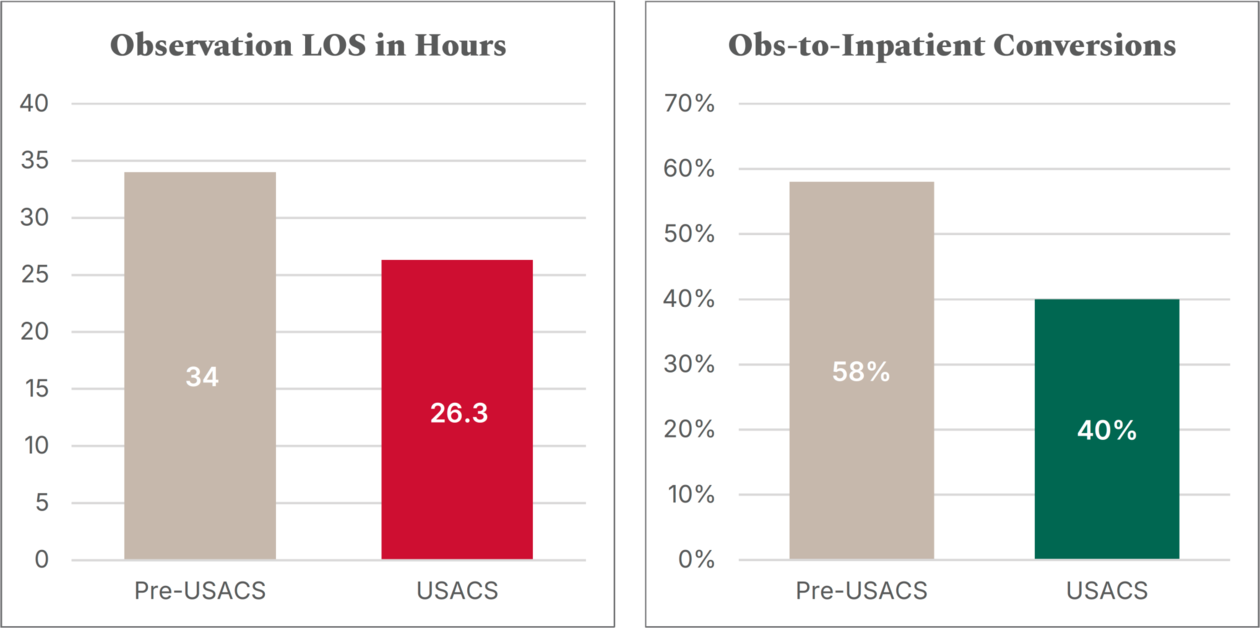
In February 2024, the health system transitioned the hospital medicine program to USACS as well. This included a 17-bed clinical decision and observation unit intended for patients who require close monitoring but do not warrant inpatient hospitalization. At the time of transition, this unit was not fully utilized for observation patients, but sometimes received admissions and transfers. LOS for observation patients, who were often scattered throughout inpatient units, averaged 34 hours. The percentage of observation patients who were later converted to inpatient status was 58%, highlighting challenges with appropriate patient selection.
| The Solution
When USACS assumes management of a hospital medicine program, it works with its partners to evaluate opportunities to improve care for the observation population, regardless of whether the hospital has a scattered model or a closed observation unit with dedicated space. When practical, USACS promotes solutions that allow observation patients to be managed in a single geographic area with a dedicated team of clinicians and nurses. Because this hospital already had a designated observation unit, USACS National Director of Observation Services Troy Myers, MD, FACEP, supported the Medical Director and the rest of the clinical team in driving improvements through changes in unit staffing, patient selection, and patient management.
Observation Unit Staffing
Myers and team established the expectation that unit beds should be reserved for observation patients, and that observation patients should only be placed outside of the unit in complex cases that require closer access to specialized resources. USACS designated 12 hours of its hospital medicine staffing to provide dedicated daytime clinician coverage in the observation unit. This clinician works with the registered nurse who is Associate Manager of the unit to promote a proactive culture in which the entire care team focuses on steadily moving each patient toward discharge.
Patient Selection
As a best practice, USACS utilizes evidence-based criteria for determining whether patients are appropriate for observation status. In the spring of 2024, USACS worked with the hospital to tailor the group’s standard observation inclusion/exclusion criteria card to align with this hospital’s guidelines and goals. When it was implemented in May, the card provided clinicians and case managers with well-defined level-of-care criteria to guide inpatient vs. observation placement. USACS also reinforced education for its hospitalists and ED clinicians on the purpose of the observation unit and the defined criteria for patient selection.
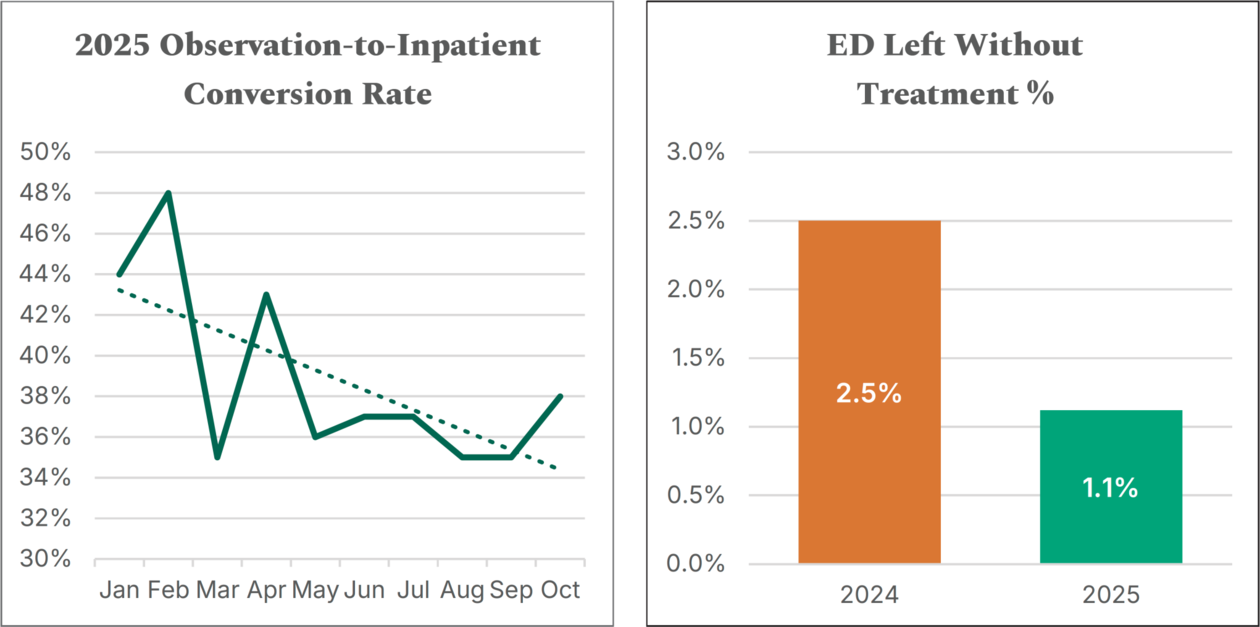
These efforts contributed to an 18% drop in observation-to-inpatient conversions, despite increased unit volumes. Lower conversion rates reduce unnecessary resource utilization, saving the hospital valuable bed space, staff time, and other costs.
“When we have a dedicated observation unit like this and the clinicians and health system are on the same page, the efficiencies are gained in hour-to-hour workflows,” Myers says. “We really have an opportunity to make a difference.”
Patient Management
Beginning in June 2024, USACS partnered with the hospital to implement several strategies for high-quality, efficient management of observation patients:
- Patient Management Guidelines—USACS implemented observation patient management guidelines to ensure a consistent, best-practice approach to care in the observation unit. As the nurses have learned the care algorithms and come to anticipate which tests each condition requires, they are empowered to advocate for their patients and prompt clinicians to move toward discharge.
- Hospital Relationships—USACS clinical leaders and observation unit nurses worked to build trust and streamline workflows with consultants and ancillary services. More responsive partnerships with imaging, laboratory, etc., lead to more efficient care for observation patients.
- History and Physical Workflow—Previously, the admitting physician in the ED performed histories and physicals for all observation and hospital medicine admissions prior to their ED departure. Now, in times of escalated ED volume, the admitter places orders for observation patients to be moved upstairs immediately and the observation clinician does history and physical in the observation unit.
- EMR Secure Chat—In November 2024, the hospital shifted to Epic as its electronic medical records platform. In Epic, ED clinicians and case managers use the secure chat function to efficiently recommend to the on-shift admitter whether they believe a patient is a candidate for the observation unit based on the inclusion/exclusion criteria card.
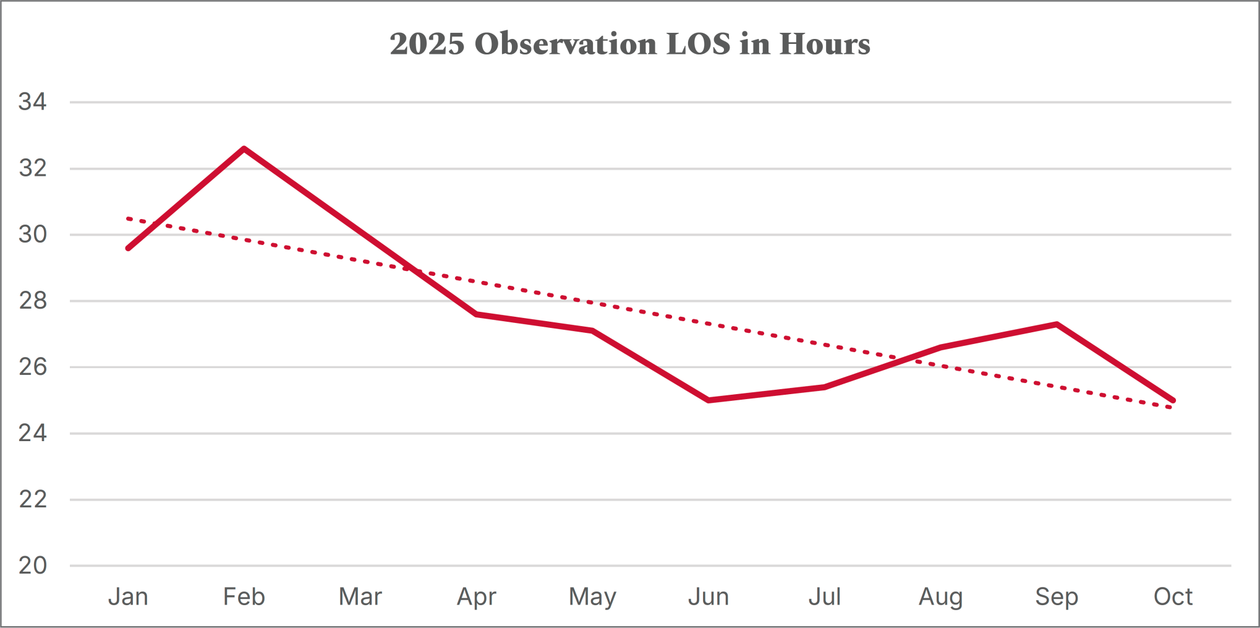
These measures decreased observation LOS from an average of 34 hours prior to USACS to an average of 26.3 hours in the 21 months following the transition. When the difference is multiplied by observation discharges during that time, the result is 904 bed days saved for the hospital. The significant LOS improvement, combined with appropriate selection of observation patients, also helped decongest the medical center’s ED, which saw a 10% year-over-year decrease in average LOS for admitted patients and a 5% decrease in median discharge LOS. The percentage of patients who left the ED without treatment in 2025 was less than half of the average for 2024.
Dyad Partnership
The observation unit’s Medical Director and Associate Manager agree that the camaraderie and focus on jointly removing barriers to discharge have made observation one of the most popular units for both clinicians and nurses working at the hospital.
“I can see the drastic improvement in the flow through the observation unit, and from the clinician standpoint, how much more efficient and well-functioning the unit is,” the Medical Director says. “You won’t find a group of nurses that are more helpful in dispositioning patients than on the observation unit.”
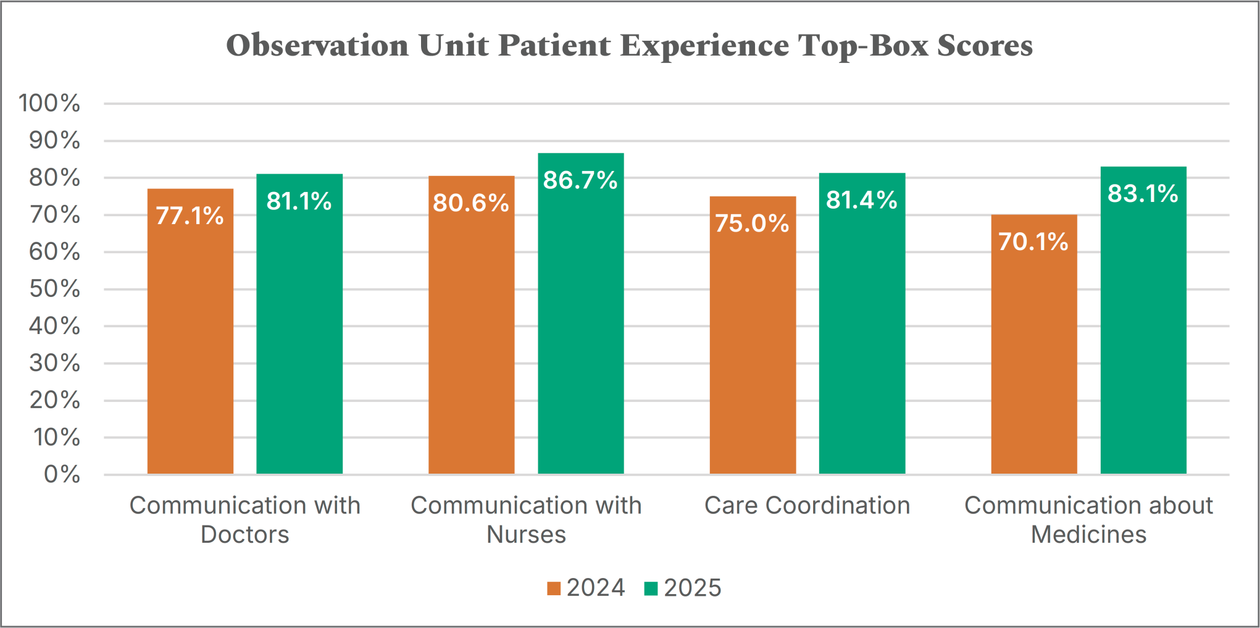
Patients are more satisfied as well. With better coordination between clinicians and nurses, the entire care team has awareness of the plan of care and takes pride in communicating next steps to patients.
In 2025, the observation unit surpassed 2024 performance in every patient experience domain. USACS looks forward to continuing to leverage its best-practice resources and strong hospital relationships to further improve quality and experience of care.
“To have a successful observation unit, you have to have a group of nurses who understand how the processes work and drive them. Physicians see patients and put in orders, but nurses are the ones who move those orders along.” -Associate Manager, Clinical Decision & Observation Unit
| The Results
After assuming management of hospital medicine and observation services at a North Carolina medical center in February 2024, US Acute Care Solutions (USACS) implemented its standard observation management program, partnering with the hospital to enhance unit staffing and patient selection and improve patient management in collaboration with the dedicated nursing team. By October 2025, these changes had resulted in:
- A 23% decrease in observation length of stay (LOS), equating to 904 bed days saved since the transition to USACS.
- An 18% drop in the observation-to-inpatient conversion rate.
- A 10% increase in year-over-year observation patient experience scores in the doctors overall domain.
“These changes help decompress the entire hospital,” says the USACS Medical Director who oversees the hospital medicine and observation programs at the medical center. “When we bring observation patients to a centralized place with one centralized care team and everyone in the hospital is on the same page for prioritizing their studies, their physical therapy evaluations, and other needs, we can get them home sooner.”
About USACS
ln 2015, the nation’s premier acute care medicine practices formed USACS, a physician-owned and physician-led company that set forth a new model for acute care management. Every full-time USACS physician is offered equity in the company, accounting for 98% of USACS’ ownership and empowering the group to recruit top-quality clinicians. The remaining 2% is held by health system partners, leaving USACS unencumbered by the volatility of private equity investment. Physician ownership aligns the missions of clinicians and hospital partners to drive higher standards in quality and value. Today USACS cares for more than 11 million patients annually across more than 470 programs in 27 states.